![[identity profile]](https://www.dreamwidth.org/img/silk/identity/openid.png)
![[personal profile]](https://www.dreamwidth.org/img/silk/identity/user.png)
![[livejournal.com profile]](https://www.dreamwidth.org/img/external/lj-userinfo.gif) electricdruid at The fiasco continues
electricdruid at The fiasco continues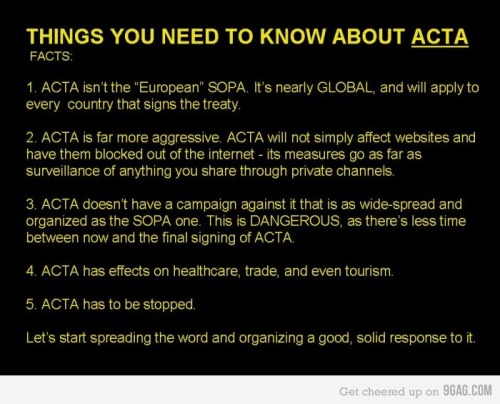
ACTA in a Nutshell –
What is ACTA? ACTA is the Anti-Counterfeiting Trade Agreement. A new intellectual property enforcement treaty being negotiated by the United States, the European Community, Switzerland, and Japan, with Australia, the Republic of Korea, New Zealand, Mexico, Jordan, Morocco, Singapore, the United Arab Emirates, and Canada recently announcing that they will join in as well.
Why should you care about ACTA? Initial reports indicate that the treaty will have a very broad scope and will involve new tools targeting “Internet distribution and information technology.”
What is the goal of ACTA? Reportedly the goal is to create new legal standards of intellectual property enforcement, as well as increased international cooperation, an example of which would be an increase in information sharing between signatory countries’ law enforcement agencies.
Essential ACTA Resources -
- Read more about ACTA here: ACTA Fact Sheet
- Read the authentic version of the ACTA text as of 15 April 2011, as finalized by participating countries here: ACTA Finalized Text
- Follow the history of the treaty’s formation here: ACTA history
- Read letters from U.S. Senator Ron Wyden wherein he challenges the constitutionality of ACTA: Letter 1 | Letter 2 | Read the Administration’s Response to Wyden’s First Letter here: Response
- Watch a short informative video on ACTA: ACTA Video
- Watch a lulzy video on ACTA: Lulzy Video
Say NO to ACTA. It is essential to spread awareness and get the word out on ACTA.
Via Tumblr
no subject
SOPA had powerful people fighting it because the technical enforcement would have messed up the Internet. Google, Wikipedia, etc, they have no problem with copyright and censorship, they just didn't like the technical enforcement aspects. (Assuming someone tweaks that side of it, SOPA will pass without comment next time.)
ACTA is a copyright and patent bill, so of course it will be terrible (we haven't had sane moves in that direction for a long time) but HOW does it intend to enforce Internet Providers controlling their users? Unless there's a way that which puts too much liability on the internet providers (and the big ones) there will likely be no political pressure to stop it. (People not wanting it won't matter.)
no subject
You can imagine that's not going down well.
no subject
The main problem with SOPA was the "all I have to do is complain and then you're blocked" aspect. If it is doing that, then sure, this will get met with resistance. If it has another process, I can't see why any of the cyber heavyweights would bother blocking it.
no subject
The way it works would be that your computer requests your ISP for Example.com, as a domain name. That's checked first against the list of blocked domains by the ISP's filter servers, if it's ok, then it's checked the ISP's DNservers, which returns the IP of xx.yy.zz.etc. But if it's on the filter's black list, the server returns an IP address for the FBI's landing page, telling you it's been blocked...and logs your own IP as well. [that's called a forced redirect].
Upshot is, your ISP needs extra machines, more internal networking for them to talk to each other, and new layer of servers between modems and actual servers.... and that's not even taking into account the hundreds of gigabytes of logs they'd have to store. [think of the number of sites you visit in a day, multiply that by hundreds of thousands of users and 2-5 years worth.] And all of that extra hardware isn't doing the core business of earning them money.
Basically ACTA is looking to increase expenditure by quite a bit, with no return, for your average ISP. And that's not even taking into account the necessary staff to ensure the compliance paperwork is filled in, that inspections are carried out and so on and so forth... all on their dime.
no subject
no subject
no subject
no subject
no subject
It's enough to give sys-adims nightmares.
no subject
no subject
thing is.. the opposition to SOPA did NOT come from the big businesses at first, that came later, it was true grass roots movement, and largely was the users kicking up a fuss that galvanised the likes of google into jumping on the band-wagon. A lot of the big players were at least not against it, or even supported it, at first.
Figure ACTA is getting an easy ride so far because it was less well know, but that's changing.